
Anything you can do for your nails? Lots!
Your nails are “just protein.” So how come you can improve your nail’s health and appearance? Just like you can improve your hair appearance and health, even though the hair is “just protein.” The same for eyelashes and eyebrows. Because although they are mostly inert protein, we can influence the process that makes them.
You can do two things: improve the health and appearance as the nails are formed and prevent damage once they are formed.
What are nails?
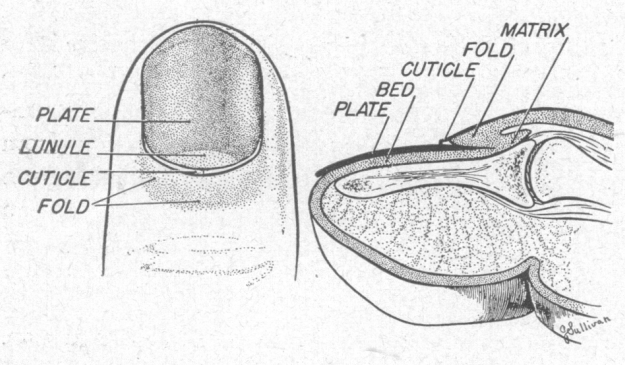
Figure. Nail anatomy. From Edwards (1948)
The horny plates that grow on the back of each finger and toe are the equivalent of the claws in our cats. In higher primates, including us, the claws became flattened as nails; they are more useful in manual activity than claws are. Nails are part of the human integument covering our body, including skin and hair. Nails are made of alpha keratin, a protein.
How are they made?
The nail apparatus is formed from an invagination of the primitive epidermis on the upper side of the terminal phalanges of fingers and toes. It is similar, in origin, to the hair. The keratin in the nail is not that different from that in hair, but the nail contains more calcium.
The nail matrix is the tissue under the nail and contains nerves, lymph, and blood vessels. The matrix produces cells that become the nail plate and will continue to produce cells as long as it receives nutrition and remains healthy. As new nail plate cells are made, they push older nail plate cells forward; the older cells become compressed, flat, and translucent.
Nails grow more slowly than hair, 1/8 of an inch per month (as compared with 1/4 to 1/2 inch per month for hair). We know that nails can hurt, and the many nerves that reach the nail bed let us know when we catch one in a car door. Nails can be damaged enough that they fall off, but even without any of those painful accidents, sometimes they grow slowly and/or badly. Why?
Just like our hair, made of “just” protein, needs a lot of nutrition to grow normally, our nails, also made of protein, need lots of nutrients. This is because live cells are in charge of producing these proteins. Once that you realize that nails and hair have much in common, it is not surprising that keratinocyte growth factor (KGF) works as well for nails as it does for hair.
When we forget or we are unlucky, the weakened tissue will provide a good environment for nail fungus. This is a problem difficult to treat and antifungals taken orally can lead to serious side effects (because fungi are eukaryotes just like we are).
What Skin Actives can do for your nails
Nails protect our fingers and toes; we must protect them and preserve their health.
Try our nail care serums if you wish to have your nails grow healthy. The SAS nail care oil will supply some nutrients that are also required by the nail but are not present in our water-based Nail Care Serum. This nail serum duo will become even more useful if you tend to mistreat your nails, and nail polish (and nail polish remover) can be part of that “mistreatment.”
What is in the SAS nail care oil? The base is our traditional EMUlator, a combination of plant “fixed” oils that provide fatty acids composition similar to that present in emu oil to provide nutrition and to enhance the penetration of antioxidants astaxanthin, lycopene, etc. ) and antifungal essential oils, also present (clove and palmarosa). Do you need nail care oil? Yes, if your nails look unhealthy, and certainly if they show the discoloration typical of fungal infection.
Nail and Cuticle Oil: Prunus Amygdalus Dulcis (Sweet Almond) Oil, Elaeis Guineensis (Palm) Oil, Butyrospermum Parkii (Shea) Nut Butter, Linum Usitatissmum (Flax) Seed Oil, Orbignya Oleifera (Babassu) Seed Oil, Punica Granatum (Pomegranate) Seed Oil, Rosa Canina (Rosehip) Seed Oil, Mangifera Indica (Mango) Seed Butter, Curcubita Pepo (Pumpkin) Seed Butter, Hippophae Rhamnoides (Seabuckthorn) Fruit Oil, Borago Officinalis (Borage) Seed Oil, Calophyllum Inophyllum (Foraha) Nut Oil, Aleurites Moluccana (Kukui Nut) Seed Oil, Astrocaryum Tucuma Seed Butter, Garcinia Indicia (Kokum) Seed Butter, Tocotrienols, Tocopherol (Vitamin E), Astaxanthin, Lycopene, Xanthophyll, R-Alpha Lipoic Acid, Beta-Carotene, Eugenia Caryophyllata Oil, Cymbopogon Martini Oil.
Nail Serum: Water, Hamamelis Virginiana (Witch Hazel) Water, Propanediol, Apocynin, Panthenol, Caffeine, Carnitine, Niacinamide, Vitis Vinifera (Grape) Seed Extract, Glutamine, Arginine, Leucine, Serine, Cysteine, Valine, Proline, Lysine, Glycine, Asparagine, Glutamic Acid, Threonine, Alanine, Phenylalanine, Methionine, Aspartic Acid, Tyrosine, Tryptophan, Histidine, Isoleucine, Glucose, Fucoidan, Apigenin, Acacia Senegal Gum, Xanthan Gum, sh-Polypeptide-3 (Keratinocyte Growth Factor (KGF)), sh-Polypeptide-2, sh-Polypeptide-77, Superoxide Dismutase, Polysorbate 20, Propylene Glycol (and) Diazolidinyl Urea (and) Methylparaben (and) Propylparaben.
DISCLAIMER: These claims have not been evaluated by the FDA and are not intended to diagnose, cure, treat or prevent any disease.
Edwards, E. A. (1948). Nail Changes in Functional and Organic Arterial Disease. New England Journal of Medicine, 239(10), 362–365. doi:10.1056/nejm194809022391002